


Page 15 - NIS English 01-15 December, 2025
P. 15
अल्पाानााम्् अपि� वस्तूूनााम््,

             संंहति�: काार्यय संाधि�काा।।


        That is, even small things, small resources,
        when combined, can accomplish great
        results. This verse from our scriptures is
        of immense importance for the ancient
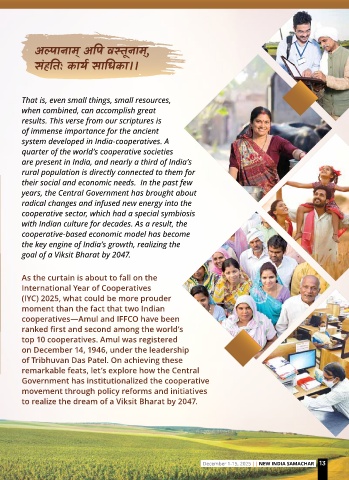
        system developed in India-cooperatives. A
        quarter of the world’s cooperative societies
        are present in India, and nearly a third of India’s
        rural population is directly connected to them for
        their social and economic needs.  In the past few

        years, the Central Government has brought about
        radical changes and infused new energy into the
        cooperative sector, which had a special symbiosis
        with Indian culture for decades. As a result, the
        cooperative-based economic model has become
        the key engine of India’s growth, realizing the
        goal of a Viksit Bharat by 2047.


        As the curtain is about to fall on the
        International Year of Cooperatives
        (IYC) 2025, what could be more prouder
        moment than the fact that two Indian

        cooperatives—Amul and IFFCO have been
        ranked first and second among the world’s
        top 10 cooperatives. Amul was registered
        on December 14, 1946, under the leadership
        of Tribhuvan Das Patel. On achieving these
        remarkable feats, let’s explore how the Central
        Government has institutionalized the cooperative

        movement through policy reforms and initiatives
        to realize the dream of a Viksit Bharat by 2047.


                                                                    December 1-15, 2025 || NEW INDIA SAMACHAR    13

