


Page 8 - NIS English 16-30 April, 2026
P. 8
PERSONALITY | Dada Saheb Phalke


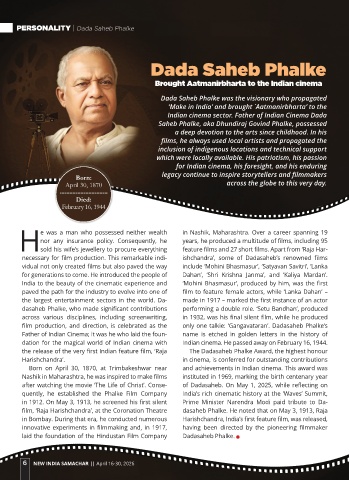
                                                   Dada Saheb Phalke


                                                    Brought Aatmanirbharta to the Indian cinema

                                                      Dada Saheb Phalke was the visionary who propagated
                                                         ‘Make in India’ and brought `Aatmanirbharta’ to the
                                                        Indian cinema sector. Father of Indian Cinema Dada
                                                     Saheb Phalke, aka Dhundiraj Govind Phalke, possessed
                                                           a deep devotion to the arts since childhood. In his
                                                      films, he always used local artists and propagated the
                                                     inclusion of indigenous locations and technical support
                                                     which were locally available. His patriotism, his passion
                                                           for Indian cinema, his foresight, and his enduring

                          Born:                       legacy continue to inspire storytellers and filmmakers
                       April 30, 1870                                       across the globe to this very day.

                          Died:
                     February 16, 1944


              e was a man who possessed neither wealth       in Nashik, Maharashtra. Over a career spanning 19
              nor  any  insurance  policy.  Consequently,  he   years, he produced a multitude of films, including 95
       Hsold his wife’s jewellery to procure everything      feature films and 27 short films. Apart from ‘Raja Har-
        necessary for film production. This remarkable indi-  ishchandra’,  some  of  Dadasaheb’s  renowned  films
        vidual not only created films but also paved the way   include ‘Mohini Bhasmasur’, ‘Satyavan Savitri’, ‘Lanka
        for generations to come. He introduced the people of   Dahan’, ‘Shri Krishna Janma’, and ‘Kaliya Mardan’.
        India to the beauty of the cinematic experience and   ‘Mohini Bhasmasur’, produced by him, was the first
        paved the path for the industry to evolve into one of   film to feature female actors, while ‘Lanka Dahan’ –
        the largest entertainment sectors in the world. Da-  made in 1917 – marked the first instance of an actor
        dasaheb Phalke, who made significant contributions   performing a double role. ‘Setu Bandhan’, produced
        across various disciplines, including screenwriting,   in 1932, was his final silent film, while he produced
        film  production,  and  direction,  is  celebrated  as  the   only one talkie: ‘Gangavataran’. Dadasaheb Phalke’s
        Father of Indian Cinema; it was he who laid the foun-  name  is  etched  in  golden  letters  in  the  history  of
        dation for the magical world of Indian cinema with   Indian cinema. He passed away on February 16, 1944.
        the release of the very first Indian feature film, ‘Raja   The Dadasaheb Phalke Award, the highest honour
        Harishchandra’.                                      in cinema, is conferred for outstanding contributions
           Born on April 30, 1870, at Trimbakeshwar near     and achievements in Indian cinema. This award was
        Nashik in Maharashtra, he was inspired to make films   instituted in 1969, marking the birth centenary year
        after watching the movie ‘The Life of Christ’. Conse-  of  Dadasaheb.  On  May  1,  2025,  while  reflecting  on
        quently, he established the Phalke Film Company      India’s rich cinematic history at the ‘Waves’ Summit,
        in 1912. On May 3, 1913, he screened his first silent   Prime Minister Narendra Modi paid tribute to Da-
        film, ‘Raja Harishchandra’, at the Coronation Theatre   dasaheb Phalke. He noted that on May 3, 1913, Raja
        in Bombay. During that era, he conducted numerous    Harishchandra, India’s first feature film, was released,
        innovative experiments in filmmaking and, in 1917,   having  been  directed  by  the  pioneering  filmmaker
        laid the foundation of the Hindustan Film Company    Dadasaheb Phalke. n


         6  NEW INDIA SAMACHAR || April 16-30, 2026

