


Page 29 - NIS English 1-15 Feb, 2026
P. 29
recommendations of the Swaminathan Commission,
        crops are being purchased at MSP with a 50% profit
        margin on the total cost, and in some cases, even
        more than 50% profit is being given. Sometimes, state
        governments are lax in procurement; therefore, the
        central government has also decided that if state gov-
        ernments purchase less or none of the tur, masoor,
        and urad crops, the central government will purchase
        them directly through agencies like NAFED, ensuring
        farmers receive a fair price.
          Between 2004 and 2014, the total quantity of Kharif
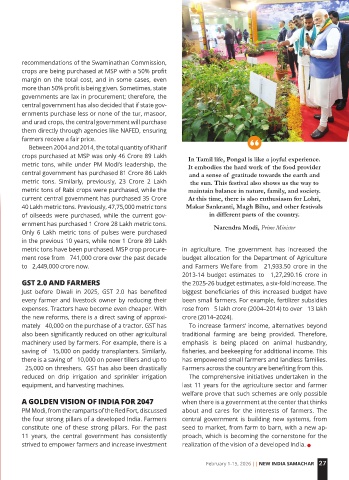
        crops purchased at MSP was only 46 Crore 89 Lakh       In Tamil life, Pongal is like a joyful experience.
        metric tons, while under PM Modi’s leadership, the     It embodies the hard work of  the food provider
        central government has purchased 81 Crore 86 Lakh      and a sense of  gratitude towards the earth and
        metric tons. Similarly, previously, 23 Crore 2 Lakh     the sun. This festival also shows us the way to
        metric tons of Rabi crops were purchased, while the    maintain balance in nature, family, and society.
        current central government has purchased 35 Crore      At this time, there is also enthusiasm for Lohri,
        40 Lakh metric tons. Previously, 47,75,000 metric tons   Makar Sankranti, Magh Bihu, and other festivals
        of  oilseeds  were  purchased,  while  the  current  gov-     in different parts of  the country.
        ernment has purchased 1 Crore 28 Lakh metric tons.              Narendra Modi, Prime Minister
        Only 6 Lakh metric tons of pulses were purchased
        in the previous 10 years, while now 1 Crore 89 Lakh
        metric tons have been purchased. MSP crop procure-   in  agriculture.  The  government  has  increased  the
        ment rose from ₹741,000 crore over the past decade   budget allocation for the Department of Agriculture
        to ₹2,449,000 crore now.                             and Farmers Welfare from  ₹21,933.50 crore in the
                                                             2013-14 budget estimates to  ₹1,27,290.16 crore in
        GST 2.0 AND FARMERS                                  the 2025-26 budget estimates, a six-fold increase. The
        Just  before  Diwali  in  2025,  GST  2.0  has  benefited   biggest  beneficiaries  of  this  increased  budget  have
        every farmer and livestock owner by reducing their   been small farmers. For example, fertilizer subsidies
        expenses. Tractors have become even cheaper. With    rose from ₹5 lakh crore (2004–2014) to over ₹13 lakh
        the new reforms, there is a direct saving of approxi-  crore (2014–2024).
        mately ₹40,000 on the purchase of a tractor. GST has   To increase farmers’ income, alternatives beyond
        also been significantly reduced on other agricultural   traditional  farming  are  being  provided.  Therefore,
        machinery used by farmers. For example, there is a   emphasis is being placed on animal husbandry,
        saving of ₹15,000 on paddy transplanters. Similarly,   fisheries, and beekeeping for additional income. This
        there is a saving of ₹10,000 on power tillers and up to   has empowered small farmers and landless families.
        ₹25,000 on threshers.  GST has also been drastically   Farmers across the country are benefiting from this.
        reduced  on  drip  irrigation  and  sprinkler  irrigation   The comprehensive initiatives undertaken in the
        equipment, and harvesting machines.                  last 11 years for the agriculture sector and farmer
                                                             welfare prove that such schemes are only possible
        A GOLDEN VISION OF INDIA FOR 2047                    when there is a government at the center that thinks
        PM Modi, from the ramparts of the Red Fort, discussed   about and cares for the interests of farmers. The
        the four strong pillars of a developed India. Farmers   central government is building new systems, from
        constitute  one  of  these  strong  pillars.  For  the  past   seed to market, from farm to barn, with a new ap-
        11 years,  the  central government has  consistently   proach, which is becoming the cornerstone for the
        strived to empower farmers and increase investment   realization of the vision of a developed India. n


                                                                     February 1-15, 2026 || NEW INDIA SAMACHAR   27

