


Page 37 - NIS English 16-31 May, 2026
P. 37
Free Trade Agreement | INTERNATIONAL

                                   Key Highlights of the Agreement


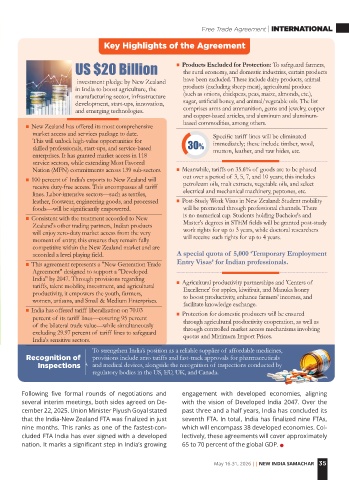
                          US $20 Billion                   n  Products Excluded for Protection: To safeguard farmers,
                                                              the rural economy, and domestic industries, certain products
                           investment pledge by New Zealand   have been excluded. These include dairy products, animal
                          in India to boost agriculture, the   products (excluding sheep meat), agricultural produce
                          manufacturing sector, infrastructure   (such as onions, chickpeas, peas, maize, almonds, etc.),
                          development, start-ups, innovation,   sugar, artificial honey, and animal/vegetable oils. The list
                          and emerging technologies.          comprises arms and ammunition, gems and jewelry, copper
                                                              and copper-based articles, and aluminum and aluminum-
                                                              based commodities, among others.
          n  New Zealand has offered its most comprehensive
            market access and services package to date.                Specific tariff lines will be eliminated
            This will unlock high-value opportunities for              immediately; these include timber, wool,
            skilled professionals, start-ups, and service-based   30%  mutton, leather, and raw hides, etc.
            enterprises. It has granted market access in 118
            service sectors, while extending Most Favored
            Nation (MFN) commitments across 139 sub-sectors.  n  Meanwhile, tariffs on 35.6% of goods are to be phased
          n  100 percent of India's exports to New Zealand will   out over a period of 3, 5, 7, and 10 years; this includes
            receive duty-free access. This encompasses all tariff   petroleum oils, malt extracts, vegetable oils, and select
            lines. Labor-intensive sectors—such as textiles,   electrical and mechanical machinery, peptones, etc.
            leather, footwear, engineering goods, and processed   n  Post-Study Work Visas in New Zealand: Student mobility
            foods—will be significantly empowered.            will be promoted through professional channels. There
          n  Consistent with the treatment accorded to New    is no numerical cap. Students holding Bachelor's and
            Zealand's other trading partners, Indian products   Master's degrees in STEM fields will be granted post-study
            will enjoy zero-duty market access from the very   work rights for up to 3 years, while doctoral researchers
            moment of entry; this ensures they remain fully   will receive such rights for up to 4 years.
            competitive within the New Zealand market and are
            accorded a level playing field.                A special quota of 5,000 ‘Temporary Employment
          n  This agreement represents a "New Generation Trade   Entry Visas’ for Indian professionals.
            Agreement" designed to support a "Developed
            India" by 2047. Through provisions regarding   n  Agricultural productivity partnerships and 'Centers of
            tariffs, talent mobility, investment, and agricultural   Excellence' for apples, kiwifruit, and Manuka honey
            productivity, it empowers the youth, farmers,     to boost productivity, enhance farmers' incomes, and
            women, artisans, and Small & Medium Enterprises.  facilitate knowledge exchange.
          n  India has offered tariff liberalization on 70.03   n  Protection for domestic producers will be ensured
            percent of its tariff lines—covering 95 percent   through agricultural productivity cooperation, as well as
            of the bilateral trade value—while simultaneously   through controlled market access mechanisms involving
            excluding 29.97 percent of tariff lines to safeguard   quotas and Minimum Import Prices.
            India's sensitive sectors.
                                To strengthen India’s position as a reliable supplier of affordable medicines,
          Recognition of        provisions include zero tariffs and fast-track approvals for pharmaceuticals
              Inspections       and medical devices, alongside the recognition of inspections conducted by
                                regulatory bodies in the US, EU, UK, and Canada.


        Following  five  formal  rounds  of  negotiations  and   engagement with developed economies, aligning
        several interim meetings, both sides agreed on De-   with the vision of Developed India 2047. Over the
        cember 22, 2025. Union Minister Piyush Goyal stated   past three and a half years, India has concluded its
        that the India-New Zealand FTA was finalized in just   seventh FTA. In total, India has finalized nine FTAs,
        nine months. This ranks as one of the fastest-con-   which will encompass 38 developed economies. Col-
        cluded FTA India has ever signed with a developed    lectively, these agreements will cover approximately
        nation. It marks a significant step in India’s growing   65 to 70 percent of the global GDP. n


                                                                        May 16-31, 2026 || NEW INDIA SAMACHAR   35

