


Page 49 - NIS English 16-30 September, 2025
P. 49
Speakers’ Conference | NATION


                                                               Central Assembly used to run
                                                               from Delhi Assembly Complex
                                                               Under the Act of 1919, during British rule, the
                                                               central legislature was expanded to a bicameral
                                                               system with the creation of the Legislative Assembly
                                                               (Lower House) and the Council of State (Upper
                                                               House). The lower house was the Central Legislative
                                                               Assembly with 144 members, of which 104 were
                                                               elected and 40 nominated. It used to function from
             Strengthened democracy                            the present Delhi Assembly building. In August
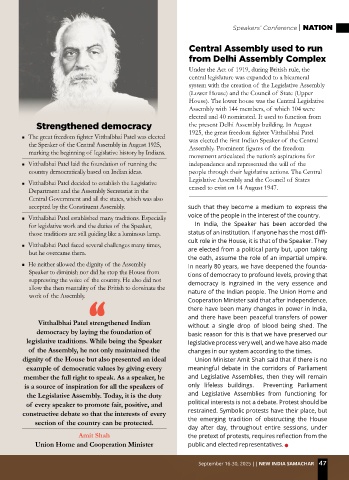
        n The great freedom fighter Vitthalbhai Patel was elected   1925, the great freedom fighter Vitthalbhai Patel
                                                               was elected the first Indian Speaker of the Central
           the Speaker of the Central Assembly in August 1925,   Assembly. Prominent figures of the freedom
           marking the beginning of legislative history by Indians.
                                                               movement articulated the nation’s aspirations for
        n Vitthalbhai Patel laid the foundation of running the   independence and represented the will of the
           country democratically based on Indian ideas.       people through their legislative actions. The Central

        n Vitthalbhai Patel decided to establish the Legislative   Legislative Assembly and the Council of States
           Department and the Assembly Secretariat in the      ceased to exist on 14 August 1947.
           Central Government and all the states, which was also
           accepted by the Constituent Assembly.               such that they become a medium to express the
        n Vitthalbhai Patel established many traditions. Especially   voice of the people in the interest of the country.
           for legislative work and the duties of the Speaker,   In  India,  the  Speaker  has  been  accorded  the
           those traditions are still guiding like a luminous lamp.  status of an institution. If anyone has the most diffi-
                                                               cult role in the House, it is that of the Speaker. They
        n Vitthalbhai Patel faced several challenges many times,
           but he overcame them.                               are elected from a political party but, upon taking
                                                               the oath, assume the role of an impartial umpire.
        n He neither allowed the dignity of the Assembly       In nearly 80 years, we have deepened the founda-
           Speaker to diminish nor did he stop the House from   tions of democracy to profound levels, proving that
           suppressing the voice of the country. He also did not   democracy is ingrained in the very essence and
           allow the then mentality of the British to dominate the
           work of the Assembly.                               nature of the Indian people. The Union Home and
                                                               Cooperation Minister said that after independence,
                                                               there have been many changes in power in India,
                                                               and there have been peaceful transfers of power
              Vitthalbhai Patel strengthened Indian            without  a  single  drop  of  blood  being  shed.  The
             democracy by laying the foundation of             basic reason for this is that we have preserved our
          legislative traditions. While being the Speaker      legislative process very well, and we have also made
          of the Assembly, he not only maintained the          changes in our system according to the times.
        dignity of the House but also presented an ideal         Union Minister Amit Shah said that if there is no
          example of democratic values by giving every         meaningful  debate  in  the  corridors  of  Parliament
         member the full right to speak. As a speaker, he      and  Legislative  Assemblies,  then  they  will  remain
         is a source of inspiration for all the speakers of    only  lifeless  buildings.    Preventing  Parliament
          the Legislative Assembly. Today, it is the duty      and  Legislative  Assemblies  from  functioning  for
          of every speaker to promote fair, positive, and      political interests is not a debate. Protest should be
        constructive debate so that the interests of every     restrained. Symbolic protests have their place, but
             section of the country can be protected.          the  emerging  tradition  of  obstructing  the  House
                                                               day after day, throughout entire sessions, under
                           Amit Shah                           the pretext of protests, requires reflection from the
             Union Home and Cooperation Minister               public and elected representatives. n


                                                                   September 16-30, 2025 || NEW INDIA SAMACHAR   47

