


Page 6 - NIS ENGLISH 1-15 May, 2026
P. 6
A New Chapter in India’s Nuclear Journey
                NEWS BRIEFS
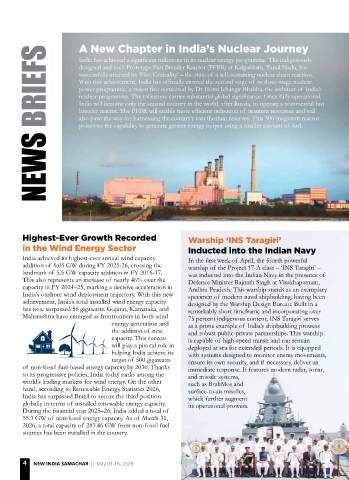
                           India has achieved a significant milestone in its nuclear energy programme. The indigenously
                           designed and built Prototype Fast Breeder Reactor (PFBR) at Kalpakkam, Tamil Nadu, has
                           successfully attained its ‘First Criticality’ – the state of a self-sustaining nuclear chain reaction.
                           With this achievement, India has officially entered the second stage of its three-stage nuclear
                           power programme, a vision first conceived by Dr Homi Jehangir Bhabha, the architect of India’s
                           nuclear programme. The milestone carries substantial global significance. Once fully operational,
                           India will become only the second country in the world, after Russia, to operate a commercial fast
                           breeder reactor. The PFBR will enable more efficient utilisation of uranium resources and will
                           also pave the way for harnessing the country’s vast thorium reserves. This 500-megawatt reactor
                           possesses the capability to generate greater energy output using a smaller amount of fuel.


        Highest-Ever Growth Recorded                           Warship ‘INS Taragiri’
        in the Wind Energy Sector                              Inducted into the Indian Navy
        India achieved its highest-ever annual wind capacity   In the first week of April, the fourth powerful
        addition of 6.05 GW during FY 2025-26, crossing the    warship of the Project 17-A class – ‘INS Taragiri’ –
        landmark of 5.5 GW capacity addition in FY 2016-17.    was inducted into the Indian Navy in the presence of
        This also represents an increase of nearly 46% over the   Defence Minister Rajnath Singh at Visakhapatnam,
        capacity in FY 2024–25, marking a decisive acceleration in   Andhra Pradesh. This warship stands as an exemplary
        India’s onshore wind deployment trajectory. With this new   specimen of modern naval shipbuilding, having been
        achievement, India’s total installed wind energy capacity   designed by the Warship Design Bureau. Built in a
        has now surpassed 56 gigawatts. Gujarat, Karnataka, and   remarkably short timeframe and incorporating over
        Maharashtra have emerged as frontrunners in both wind   75 percent indigenous content, INS Taragiri serves
                                      energy generation and    as a prime example of India’s shipbuilding prowess
                                      the addition of new      and robust public-private partnerships. This warship
                                      capacity. This success   is capable of high-speed transit and can remain
                                      will play a pivotal role in   deployed at sea for extended periods. It is equipped
                                      helping India achieve its   with systems designed to monitor enemy movements,
                                      target of 500 gigawatts   ensure its own security, and if necessary, deliver an
        of non-fossil fuel-based energy capacity by 2030. Thanks   immediate response. It features modern radar, sonar,
        to its progressive policies, India today ranks among the   and missile systems,
        world’s leading markets for wind energy. On the other   such as BrahMos and
        hand, according to Renewable Energy Statistics 2026,   surface-to-air missiles,
        India has surpassed Brazil to secure the third position   which further augment
        globally in terms of installed renewable energy capacity.   its operational prowess.
        During the financial year 2025–26, India added a total of
        55.3 GW of non-fossil energy capacity. As of March 31,
        2026, a total capacity of 283.46 GW from non-fossil fuel
        sources has been installed in the country.


         4  NEW INDIA SAMACHAR || May 01-15, 2026

