


Page 12 - NIS English 16-31 May, 2026
P. 12
The Census: A Long and Rich Tradition


        India conducted its first synchronous census in 1881. However, the earliest references to census taking in the country are
        found in ancient texts, such as Kautilya’s ‘Arthashastra’ and Abul Fazl’s ‘Ain-i-Akbari’, among others...


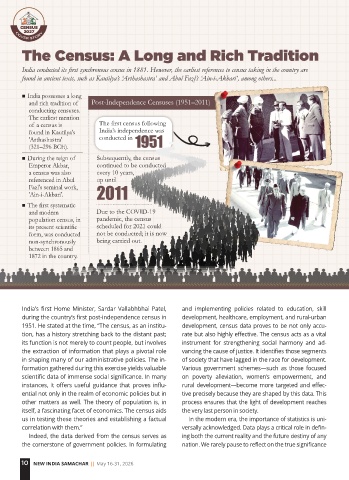
        n  India possesses a long
           and rich tradition of   Post-Independence Censuses (1951–2011)
           conducting censuses.
           The earliest mention
           of a census is         The first census following
           found in Kautilya's    India’s independence was
           'Arthashastra'         conducted in  1951
           (321–296 BCE).

        n  During the reign of   Subsequently, the census
           Emperor Akbar,        continued to be conducted
           a census was also     every 10 years,
           referenced in Abul    up until
           Fazl's seminal work,   2011
           'Ain-i-Akbari'.
        n  The first systematic
           and modern            Due to the COVID-19
           population census, in   pandemic, the census
           its present scientific   scheduled for 2021 could
           form, was conducted   not be conducted; it is now
           non-synchronously     being carried out.
           between 1865 and
           1872 in the country.


        India’s first Home Minister, Sardar Vallabhbhai Patel,   and implementing policies related to education, skill
        during the country’s first post-independence census in   development, healthcare, employment, and rural-urban
        1951. He stated at the time, “The census, as an institu-  development, census data proves to be not only accu-
        tion, has a history stretching back to the distant past;   rate but also highly effective. The census acts as a vital
        its function is not merely to count people, but involves   instrument for strengthening social harmony and ad-
        the extraction of information that plays a pivotal role   vancing the cause of justice. It identifies those segments
        in shaping many of our administrative policies. The in-  of society that have lagged in the race for development.
        formation gathered during this exercise yields valuable   Various  government  schemes—such  as  those  focused
        scientific data of immense social significance. In many   on poverty alleviation, women’s empowerment, and
        instances, it offers useful guidance that proves influ-  rural development—become more targeted and effec-
        ential not only in the realm of economic policies but in   tive precisely because they are shaped by this data. This
        other matters as well. The theory of population is, in   process ensures that the light of development reaches
        itself, a fascinating facet of economics. The census aids   the very last person in society.
        us in testing these theories and establishing a factual   In the modern era, the importance of statistics is uni-
        correlation with them.”                              versally acknowledged. Data plays a critical role in defin-
           Indeed, the data derived from the census serves as   ing both the current reality and the future destiny of any
        the cornerstone of government policies. In formulating   nation. We rarely pause to reflect on the true significance


        10  NEW INDIA SAMACHAR || May 16-31, 2026

