


Page 13 - NIS English 16-31 May, 2026
P. 13
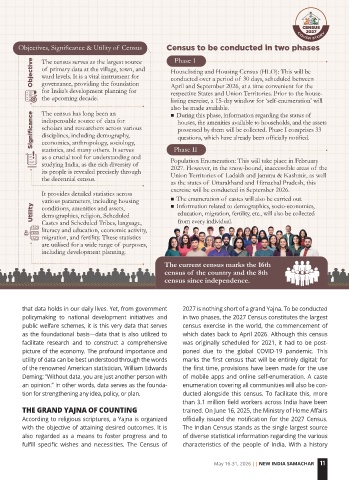
Objectives, Significance & Utility of Census     Census to be conducted in two phases

                                                           Phase 1
            Objective  The census serves as the largest source   Houselisting and Housing Census (HLO): This will be
               of primary data at the village, town, and
               ward levels. It is a vital instrument for
                                                         conducted over a period of 30 days, scheduled between
               governance, providing the foundation
               for India’s development planning for      April and September 2026, at a time convenient for the
                                                         respective States and Union Territories. Prior to the house-
               the upcoming decade.                      listing exercise, a 15-day window for ‘self-enumeration’ will
                                                         also be made available.
               The census has long been an
                                                         n  During this phase, information regarding the status of
            Significance  indispensable source of data for   houses, the amenities available to households, and the assets
               scholars and researchers across various
                                                            possessed by them will be collected. Phase I comprises 33
               disciplines, including demography,
                                                            questions, which have already been officially notified.
               economics, anthropology, sociology,
                                                          Phase II
               statistics, and many others. It serves
               as a crucial tool for understanding and   Population Enumeration: This will take place in February
               studying India, as the rich diversity of   2027. However, in the snow-bound, inaccessible areas of the
               its people is revealed precisely through   Union Territories of Ladakh and Jammu & Kashmir, as well
               the decennial census.
                                                         as the states of Uttarakhand and Himachal Pradesh, this
                                                         exercise will be conducted in September 2026.
               It provides detailed statistics across
               various parameters, including housing     n  The enumeration of castes will also be carried out.
                                                         n  Information related to demographics, socio-economics,
            Utility  conditions, amenities and assets,      education, migration, fertility, etc., will also be collected
               demographics, religion, Scheduled
                                                            from every individual.
               Castes and Scheduled Tribes, language,
               literacy and education, economic activity,
               migration, and fertility. These statistics
               are utilised for a wide range of purposes,
               including development planning.

                                                       The current census marks the 16th
                                                       census of  the country and the 8th
                                                       census since independence.


        that data holds in our daily lives. Yet, from government   2027 is nothing short of a grand Yajna. To be conducted
        policymaking to national development initiatives and   in two phases, the 2027 Census constitutes the largest
        public welfare schemes, it is this very data that serves   census exercise in the world, the commencement of
        as the foundational basis—data that is also utilized to   which dates back to April 2026. Although this census
        facilitate research and to construct a comprehensive   was  originally  scheduled  for  2021,  it  had  to  be  post-
        picture of the economy. The profound importance and   poned due to the global COVID-19 pandemic. This
        utility of data can be best understood through the words   marks the first census that will be entirely digital; for
        of the renowned American statistician, William Edwards   the first time, provisions have been made for the use
        Deming: “Without data, you are just another person with   of mobile apps and online self-enumeration. A caste
        an opinion.” In other words, data serves as the founda-  enumeration covering all communities will also be con-
        tion for strengthening any idea, policy, or plan.    ducted alongside this census. To facilitate this, more
                                                             than 3.1 million field workers across India have been
        THE GRAND YAJNA OF COUNTING                          trained. On June 16, 2025, the Ministry of Home Affairs
        According to religious scriptures, a Yajna is organized   officially  issued  the  notification  for  the  2027  Census.
        with the objective of attaining desired outcomes. It is   The Indian Census stands as the single largest source
        also regarded as a means to foster progress and to   of diverse statistical information regarding the various
        fulfill  specific  wishes  and  necessities.  The  Census  of   characteristics of the people of India. With a history


                                                                        May 16-31, 2026 || NEW INDIA SAMACHAR   11

