


Page 24 - NIS English 1-15 July, 2026
P. 24
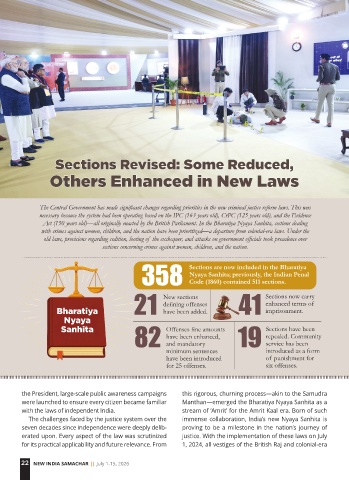
Sections Revised: Some Reduced,

                 Others Enhanced in New Laws


              The Central Government has made significant changes regarding priorities in the new criminal justice reform laws. This was
              necessary because the system had been operating based on the IPC (163 years old), CrPC (125 years old), and the Evidence
               Act (150 years old)—all originally enacted by the British Parliament. In the Bharatiya Nyaya Sanhita, sections dealing
               with crimes against women, children, and the nation have been prioritized—a departure from colonial-era laws. Under the
               old laws, provisions regarding sedition, looting of  the exchequer, and attacks on government officials took precedence over
                                   sections concerning crimes against women, children, and the nation.
                                                358            Sections are now included in the Bharatiya


                                                               Nyaya Sanhita; previously, the Indian Penal
                                                               Code (1860) contained 511 sections.
                                             21        New sections             41       Sections now carry

                                                                                         enhanced terms of
                                                       defining offenses
                    Bharatiya                          have been added.                  imprisonment.
                      Nyaya
                                             82         have been enhanced,     19       repealed. Community
                     Sanhita                            Offenses fine amounts            Sections have been

                                                        and mandatory
                                                                                         introduced as a form
                                                        minimum sentences                service has been
                                                        have been introduced             of punishment for
                                                        for 25 offenses.                 six offenses.


        the President, large-scale public awareness campaigns   this rigorous, churning process—akin to the Samudra
        were launched to ensure every citizen became familiar   Manthan—emerged the Bharatiya Nyaya Sanhita as a
        with the laws of independent India.                  stream of ‘Amrit’ for the Amrit Kaal era. Born of such
          The challenges faced by the justice system over the   immense collaboration, India’s new Nyaya Sanhita is
        seven decades since independence were deeply delib-  proving to be a milestone in the nation’s journey of
        erated upon. Every aspect of the law was scrutinized   justice. With the implementation of these laws on July
        for its practical applicability and future relevance. From   1, 2024, all vestiges of the British Raj and colonial-era


        22  NEW INDIA SAMACHAR || July 1-15, 2026

